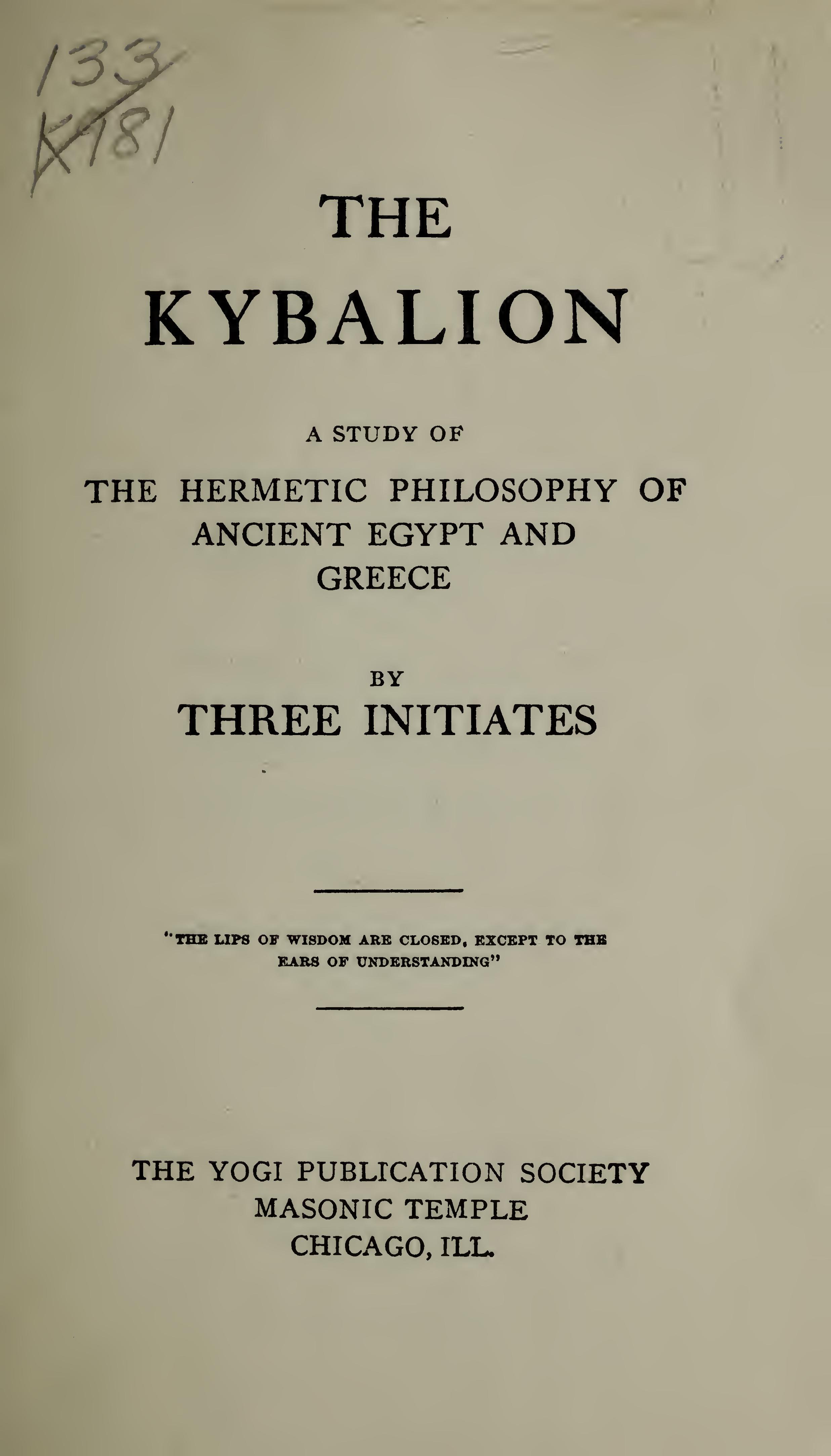

In 1908 a small blue hardcover appeared from the Yogi Publication Society, an outfit operating out of the Masonic Temple building in Chicago. Its title page promised the Hermetic philosophy of ancient Egypt and Greece, and its authors declined to give their names, signing themselves only as "Three Initiates."
More than a century later, The Kybalion is one of the most quoted occult books in the English language. Its seven principles turn up in self-help seminars and countless social media explainers, almost always introduced as the lost wisdom of the pharaohs. The book is interesting, influential and worth reading. It is also a product of early twentieth century Chicago, and the evidence for that is not subtle.
What the book says about itself
The Kybalion opens with a dedication to Hermes Trismegistus and a bold historical claim. Hermes, it says, lived in Egypt when the human race was young, and was "Contemporary with Abraham," possibly even his teacher.
According to the introduction, the teachings were never written down. They traveled from master to student by word of mouth as a collection of maxims and axioms known as the Kybalion, a word whose meaning, the authors concede, had been lost for several centuries. The modern book presents itself as a commentary on those sayings, quoting them in short oracular lines such as "The lips of Wisdom are closed, except to the ears of Understanding."
Then come the seven principles: Mentalism (the universe is fundamentally mental), Correspondence (patterns repeat across the planes of existence), Vibration (nothing is ever at rest), Polarity (opposites are the same thing in different degrees), Rhythm (everything swings like a pendulum), Cause and Effect (nothing happens by chance) and Gender (masculine and feminine principles operate in everything).
It is a tidy system, clearly explained, and that tidiness is the first clue. The ancient Hermetic writings are many things. Tidy is not one of them.
The man behind the curtain
The strongest candidate for all three of the Three Initiates is one person: William Walker Atkinson (1862 to 1932), a lawyer who, around the turn of the century, went missing for several weeks and re-emerged in Chicago as a writer on metaphysics and the philosophy known as New Thought.
Atkinson was astonishingly productive, and fond of masks. He published under his own name and under a wardrobe of pseudonyms, including Theron Q. Dumont, Magus Incognito and Yogi Ramacharaka, an Indian sage who did not exist and who nonetheless produced at least thirteen books. Atkinson also ran the Yogi Publication Society, the firm that issued The Kybalion.
Keep reading. The rest of this story is free with your email at https://alchemy.expert/articles/kybalion-is-not-ancient-seven-hermetic-principles.