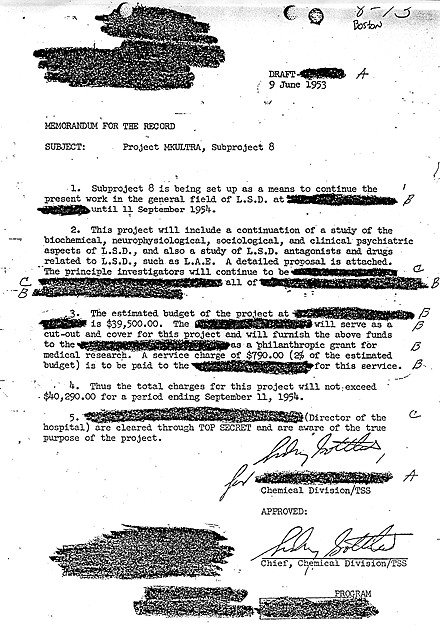

In January 1973, on the instruction of CIA Director Richard Helms, the agency destroyed the files of a program it had run for two decades. The shredding nearly worked. What survived is enough to establish that the United States government secretly gave LSD to its own citizens, some of whom never knew it, and that at least one of them died.
The program was called MKUltra. It has since become a magnet for every mind control theory going, which makes it worth separating the paper trail from the folklore. The paper trail is strange enough.
A Cold War shopping list
MKUltra was authorized in 1953 by Allen Dulles, the director of Central Intelligence. It grew out of earlier efforts with names like BLUEBIRD, begun in 1950, and ARTICHOKE, which explored hypnosis, drugs and special interrogation methods. The fear driving all of it, as a CIA official later told the Senate, was that the country's enemies might use drugs against Americans. The agency wanted to know what such substances could do, and whether it could do it first.
The man in charge was Sidney Gottlieb, a chemist who ran the Chemical Division of the CIA's Technical Services Staff. Under him, MKUltra became less a single experiment than an umbrella. When Admiral Stansfield Turner, a later CIA director, described the recovered records to Congress in 1977, he counted 149 subprojects. They touched 80 institutions: 44 colleges or universities, 15 research foundations or chemical and pharmaceutical companies, 12 hospitals or clinics, and 3 prisons. The files named 185 researchers outside government, and the money sometimes moved through intermediaries so that it appeared to come from private sources.
Much of this was ordinary, if covertly financed, research into drugs, hypnosis and behavior. Some of it was not.
The unwitting
Documents collected by the National Security Archive show where the program crossed lines that were already clear at the time. Prisoners at the federal penitentiary in Atlanta were given LSD. So were patients at a federal addiction hospital in Lexington, Kentucky, where the reward for taking part could be more drugs. In Montreal, the psychiatrist D. Ewen Cameron, director of the Allan Memorial Institute, subjected patients to a regime he called depatterning: drug-induced sleep, repeated electroshock and looped recorded messages, sometimes for weeks.
Then there were the safe houses. Gottlieb recruited George White, a federal narcotics agent, to run CIA apartments in New York and San Francisco. Working under an alias, White slipped LSD to people who had no idea they were test subjects, then watched what happened. Senator Edward Kennedy, opening the 1977 hearing, summarized the recovered records as showing "covert drug tests on unwitting citizens at all social levels."
The CIA's own inspector general saw the problem. A report dated July 26, 1963 recommended ending tests on unwitting Americans. It also noted, with some understatement, that the office running the work "has pursued a philosophy of minimum documentation."
Frank Olson
The best documented casualty was Frank Olson, a 43-year-old Army bacteriologist who worked on biological weapons at Camp Detrick in Maryland. On November 19, 1953, at a retreat at Deep Creek Lake, Gottlieb spiked Olson's drink with LSD. Olson had not agreed to it and did not know.
Olson did not recover his balance. Nine days later, in the early hours of November 28, he went through a tenth-floor window of the Hotel Statler in New York. A government chemist, Robert Lashbrook, was sharing the room. The family was told it was a suicide and was told nothing about the drug.
They learned the rest 22 years later, when the Rockefeller Commission's 1975 report disclosed the LSD connection. President Gerald Ford invited the Olsons to the White House on July 21, 1975 and apologized. Congress approved a payment of $750,000.
Here the documentary record stops and a dispute begins. Olson's sons came to believe their father was killed because he had become a security risk. A forensic team that exhumed the body in 1994 reported injuries it considered suggestive of homicide, and the family sued in 2012; the case was dismissed. The murder theory has never been proven. What is proven is the drugging, the silence and the apology.
What the shredder missed
MKUltra faded out by the early 1970s, and in January 1973 its records were destroyed. Had events gone differently, that might have been the end of it.
Instead, in December 1974, reporter Seymour Hersh revealed in The New York Times that the CIA had been spying on Americans at home. The Rockefeller Commission followed, then the Senate's Church Committee, whose final report devoted a chapter to the testing of chemical and biological agents by the intelligence agencies. Investigators kept running into the same wall: the files were gone.
Not all of them. In 1977, after a Freedom of Information Act request, a CIA employee searching the agency's Retired Records Center found seven boxes of MKUltra financial records that had escaped the purge. They were accounts, not lab notes, but they showed who was paid and for what. The Senate Select Committee on Intelligence, chaired by Daniel Inouye, held a joint hearing with Kennedy's health subcommittee on August 3, 1977. Turner told the public that he found the idea of using a human being as a guinea pig abhorrent, and that the experimentation had stopped. More than five thousand pages of documents were released.
What the record does and does not show
The surviving documents describe a government agency testing drugs on people without their consent, hiding the money, discouraging written records, and then destroying most of what was written anyway. They do not describe a working method for controlling a human mind. Nothing in the released files or the 1977 testimony shows that anyone was turned into a programmed assassin, and the grander claims attached to the name MKUltra rest on inference, not paper.
That gap is the real legacy. Because the files were destroyed, nobody can say with certainty how many people were dosed, who they were, or what became of them. A conspiracy theory fills a vacuum, and this vacuum was manufactured on purpose. The lesson of MKUltra is less about the power of psychedelic drugs than about what an institution will do when it is confident that nobody will ever be allowed to check.