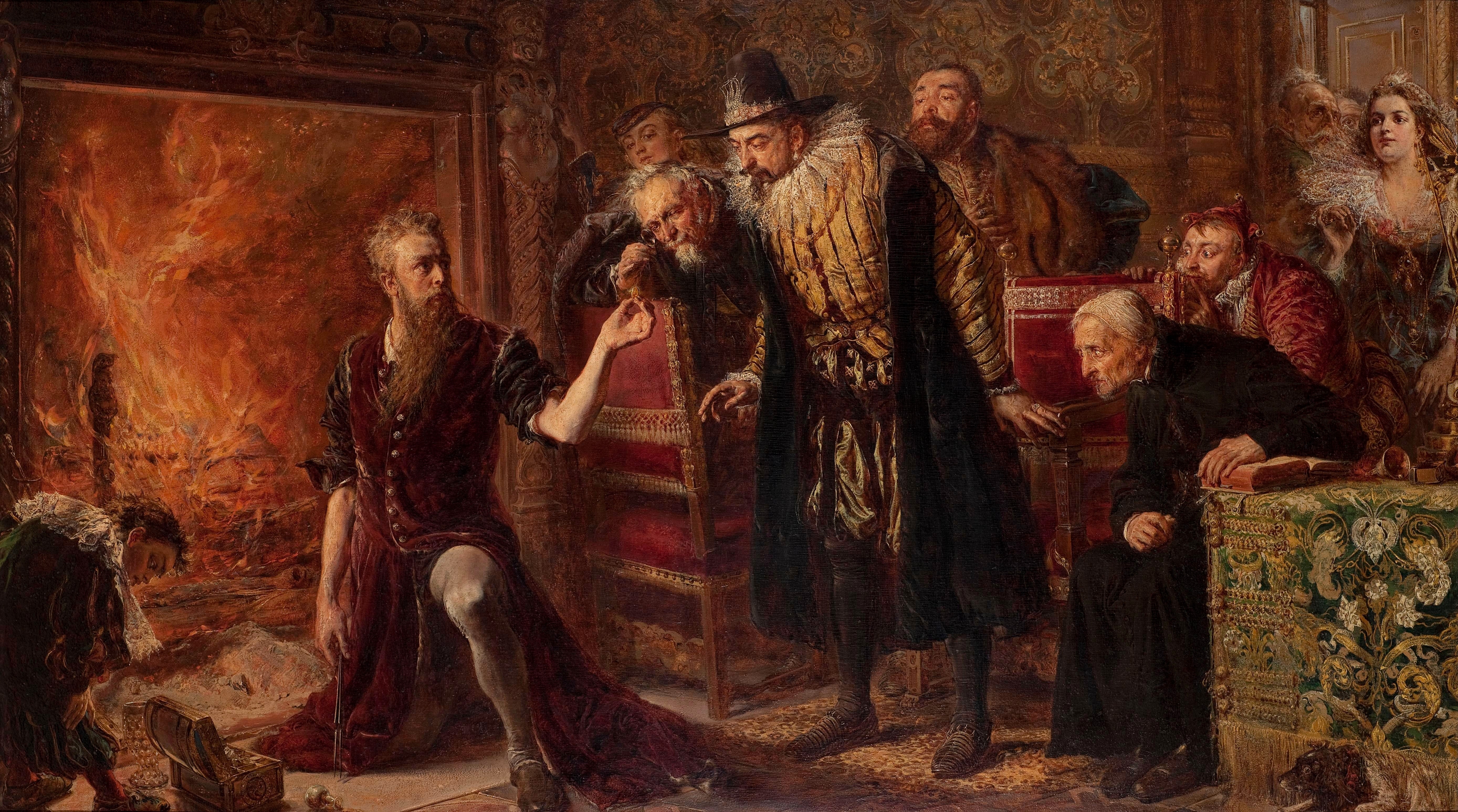

On July 13 and 14, 1936, Sotheby's in London sold off the private papers of Isaac Newton. The whole lot, the unpublished working life of the most celebrated scientist in history, fetched just over £9,000.
What the buyers took home was not more physics. Of the 329 lots in the catalogue, more than a third were, as the editors of Newton's alchemical papers put it, undeniably alchemical. The man who gave the world universal gravitation had also spent decades at a furnace, chasing the philosopher's stone.
Not fit to be printed
The papers had been hidden in plain sight for two centuries. When Newton died in 1727 without a will covering his manuscripts, they were examined by Thomas Pellet, who marked most of them with a phrase that has followed them ever since: "Not fit to be printed."
According to an account in the Science History Institute's Distillations magazine, the manuscripts passed to Newton's half-niece Catherine Conduitt and her husband John, and then, through their daughter's marriage in 1740, into the family of the Earls of Portsmouth. There they sat, largely unread, for about 145 years.
In 1872 the fifth Earl offered the scientific papers to Cambridge University. Two eminent mathematical physicists, George Gabriel Stokes and John Couch Adams, led the sorting, a job that took sixteen years. Cambridge kept the mathematics and the science. Most of the alchemy and theology went back to the family.
By 1936 the family needed money. Distillations reports that Gerard Wallop, then Viscount Lymington, faced death duties of £300,000, and the returned papers went to auction. London's rare book dealers kept the bidding low, and the material scattered.
Two buyers saved it from disappearing altogether. One was Abraham Yahuda, a scholar who concentrated on the theological manuscripts; his collection eventually went to the National Library of Israel. The other was the economist John Maynard Keynes, who, according to the Newton Project, was alerted to the sale late and then set about acquiring the alchemical manuscripts in particular. He left them to King's College, Cambridge, on his death in 1946.
Keynes read what he had bought, by his own estimate at least 100,000 words of the alchemy alone. He wrote up his conclusions in a lecture, "Newton, the Man," intended for the Royal Society's celebration of the 300th anniversary of Newton's birth. The celebration was postponed by the war until July 1946. Keynes died that April, and his brother Geoffrey delivered the lecture in his place.
It contained one of the most quoted lines in the history of science. Newton, Keynes declared, was not the first of the age of reason. He was "the last of the magicians."
A million words
Keynes saw only part of the picture. The Chymistry of Isaac Newton, a project based at Indiana University and led by the historian William R. Newman, estimates that Newton wrote and transcribed about a million words on alchemy. Only a tiny fraction had ever been published.
That project, funded by the National Science Foundation and the National Endowment for the Humanities, has been putting the manuscripts online as scans beside searchable transcriptions. In October 2011 the university announced that all 59 of the Keynes alchemical manuscripts in Newton's hand had been edited.
The papers show a methodical mind. Newton was especially devoted to the writings of "Eirenaeus Philalethes," the pen name of George Starkey, a scientist from colonial America whose work he studied for more than thirty years. In the 1680s he compiled an Index Chemicus, a 94-folio guide to alchemical terms and substances that went through several drafts.
What the furnace shows
The most striking results have come from the laboratory, not the archive. Newman's team has rebuilt Newton's experiments, and in 2005, for a television documentary, even constructed a working replica of one of his furnaces.
The notebooks describe a characteristic procedure. Newton would make aqua regia from sal ammoniac and nitric acid, react it with stibnite, the ore of antimony, and then carry the products through further reactions with metals and minerals before evaporating or subliming the results. Replications at Indiana have shown that these sublimations produced complex double salts of the metals involved, making normally fixed metals volatile and leaving bands of colored crystals in the glass.
In other words, the experiments worked. They did not produce gold, but they gave reproducible, visually dramatic results, and Newton believed they were steps toward the stone. He kept at it from the mid 1660s into the early 1700s, by which time he was one of the most prominent figures in the Royal Society.
Newton's reading list explains his confidence. Alongside Starkey he studied Michael Sendivogius and Johann de Monte-Snyders, respected names in a field that in the 17th century was not yet separate from chemistry. The Indiana editors use the period word "chymistry" for that reason. It covered commercial work on pigments, acids and distillation, the making of mineral medicines, and chrysopoeia, the attempt to make gold. Newton was interested in all three.
Magician or chemist?
Here the popular story needs correcting. Keynes's line is irresistible, and it did real service in forcing historians to take the manuscripts seriously. The Newton Project credits the 1936 sale with revealing the full extent of Newton's interests in alchemy and unorthodox theology, and with transforming scholarship on him.
But "magician" misdescribes what the papers show. Newman's 2018 book Newton the Alchemist, built on the manuscripts and on laboratory replication, argues that Newton fits neither caricature: not the pure Enlightenment rationalist of the monuments, and not an irrational mystic either. He was an experimentalist.
What it changes
The discovery does not shrink Newton. It corrects the picture of how science came to be. The tidy story has reason arriving in the 17th century and sweeping superstition away. The manuscripts show something messier: the same person, in the same decades, writing the Principia and tending a furnace, and seeing no contradiction.
The line between chemistry and alchemy was drawn afterward, by people who knew which half had worked. Newton did not have that luxury. He had only the experiments, and he ran them.