
In 1888, three London Freemasons opened a temple on the authority of a German countess who probably never existed, using rituals decoded from a manuscript nobody could trace. Within a decade their creation had enrolled one of the greatest poets in the English language and quietly drafted the template for modern occultism.
The Hermetic Order of the Golden Dawn lasted, in its original form, about fifteen years. The scholar Dennis Denisoff calls it "the most influential hermetic society of the nineteenth century," and the claim is hard to argue with. Much of what now passes for ancient magical tradition was assembled in Victorian drawing rooms by this group.
The founders were Dr. William Wynn Westcott, Dr. William Robert Woodman and Samuel Liddell Mathers, an occult scholar who styled himself MacGregor Mathers and had a flair for ceremony. All three were Freemasons with a taste for Rosicrucian legend.
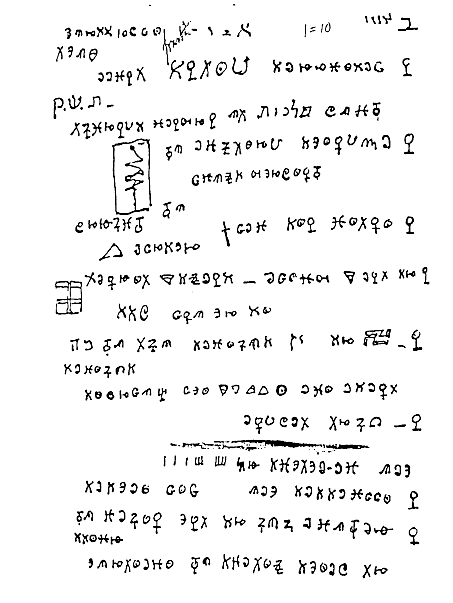
Their raw material was a bundle now known as the Cipher Manuscripts: 60 folios in black ink on paper watermarked 1809, written in a cipher devised by the abbot Trithemius in the 16th century. Decoded, the pages turned out to be in English. They gave outline rituals for a series of initiatory grades and a course of occult study.
Westcott deciphered them in 1887. Mathers then expanded the skeletons into working ceremonies. In 1888 the Isis-Urania Temple opened in London, with sister temples in Weston-super-Mare and Bradford the same year.
The countess who never wrote back
Every secret society wants a pedigree, and Westcott supplied one. He said the manuscripts had led him to a certain Fräulein Anna Sprengel, a high-ranking Rosicrucian adept in Germany, and that she had written to authorize an English branch and to grant the three founders honorary rank.
No independent evidence for Sprengel or her German lodge has ever turned up. The temple's founding charter was written and signed by Westcott, Mathers and Woodman only, not by her. Scholars have proposed that Sprengel was an invention of Westcott's, and some suspect the Cipher Manuscripts themselves were a recent confection, possibly the work of the Masonic writer Kenneth Mackenzie, rather than a relic of an old brotherhood. Denisoff dates them to the 1870s, not long before they surfaced. One internal clue supports a late date: the text draws on Egyptian material that was not available in translation until the 1840s.
The honest summary is that nobody knows who wrote the founding documents, and that Westcott's story about them does not hold up. The lineage was, in all likelihood, a Victorian fiction. What the members built on it was real enough.
Who joined, and why it mattered
The order was organized like a university with costumes. Members progressed through the study grades of an Outer Order toward an Inner Order. Mathers finished the Inner Order's rituals in 1891 and, after Woodman's death, became its dominant figure. Above everything sat a third level of "secret chiefs," superhuman adepts with whom, usefully, only Mathers claimed contact.
Two things set the Golden Dawn apart. First, it was a synthesis. Kabbalah, astrology, tarot, alchemy and Egyptian imagery had been separate pursuits; the order welded them into one graded system. Second, unlike the Masonic lodges it borrowed from, it admitted women as equals, and women ran much of it.
The actress Florence Farr became head of the order in England in 1892 and later took over Westcott's duties when he resigned in 1897. Annie Horniman, later a theater producer, was a member, as was Mathers's wife Moina, an artist and the sister of the philosopher Henri Bergson. The Irish nationalist Maud Gonne joined in November 1891.
The most famous recruit was W. B. Yeats, who took the magical motto Demon Est Deus Inversus. The National Library of Ireland still holds his occult papers, including a 1901 letter to fellow adepts signed with the motto's initials, D.E.D.I. This was no youthful phase: he was still writing to fellow initiates about the order's affairs a year after it began to tear itself apart.
Membership was mostly middle class and reached the hundreds at its peak in the 1890s.
1900: the magicians fall out
The collapse came quickly. Mathers had already expelled Horniman after a quarrel in the mid-1890s. In 1898 a young poet named Aleister Crowley was initiated. The London adepts refused to advance him to the Inner Order. Mathers overruled them and initiated Crowley himself.
The result was open rebellion. Farr resigned her post, and in the spring of 1900 the London members expelled their own founder. Mathers set up a rival order, the Alpha et Omega.
Worse followed. A pair of American confidence tricksters calling themselves Mr. and Mrs. Horos had deceived Mathers in Paris. In 1901 Mr. Horos was convicted in London of raping a sixteen-year-old girl, and the trial dragged the Golden Dawn's initiation rituals into open court and the newspapers. Members resigned in numbers, and the survivors dropped the tainted name.
By 1903 the pieces had gone separate ways. Arthur Edward Waite led one branch, which ran until 1914. Robert Felkin founded the Stella Matutina, which had spread to New Zealand by 1912.
The afterlife in a deck of cards
The order's reach is easiest to see in tarot. In 1909 the London publisher Rider issued a deck designed by Waite and painted by Pamela Colman Smith, both Golden Dawn initiates. Earlier decks gave the numbered suit cards plain arrangements of cups or swords. Smith drew a full allegorical scene for each of the 56, which is the reason anyone can now look at a tarot card and tell a story about it. Hyperallergic describes it as the first deck mass-marketed in English with original art, and it remains the most popular tarot of the past century.
The system outlived the organization. Some successor temples lasted into the second half of the 20th century, and groups claiming Golden Dawn lineage operate today. Crowley, for his part, took what he had learned and built his own religion.
A useful forgery
The Golden Dawn is a strange success story. Its origin myth was almost certainly false, its founders fell out, and it could not survive one courtroom scandal. Yet the system its members wrote became the common grammar of modern ceremonial magic.
Denisoff suggests reading the order as a work of collective Victorian authorship, and that may be the fairest verdict. Its members did not inherit an ancient tradition. They wrote one, and it has outlasted the letters from Germany that were supposed to prove it.