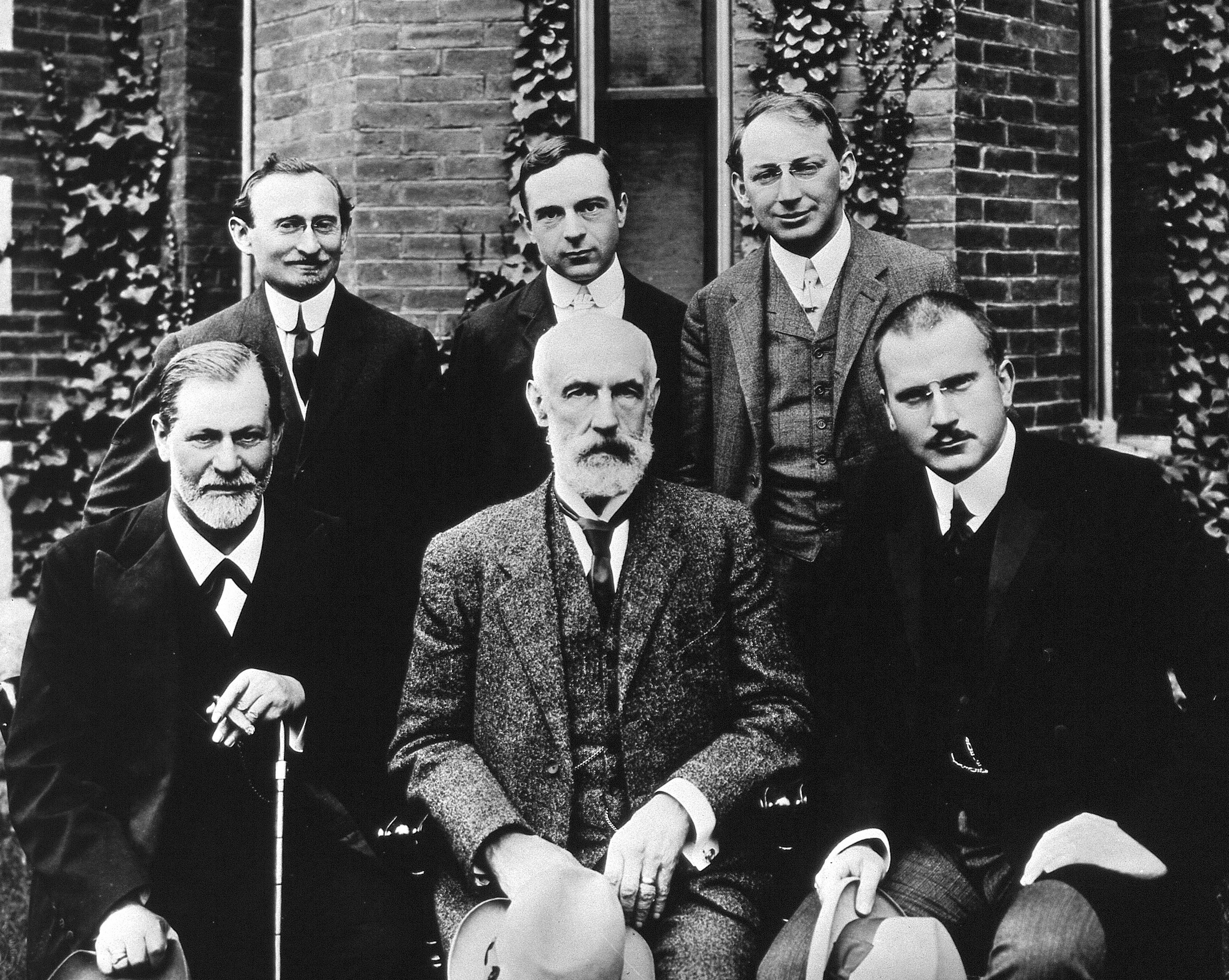

In November 1899 a Viennese neurologist published a book arguing that every dream, however absurd, is a coded message from the dreamer to the dreamer. The first printing ran to 600 copies and took eight years to sell.
The book was The Interpretation of Dreams. Its publisher dated the title page 1900, which suited a work that Sigmund Freud believed would open a new century. Within fifteen years his most brilliant follower had reached nearly the opposite conclusion and been cast out for it. The laboratory, when it finally weighed in, declined to crown either man.
Freud: the dream as disguise
Freud's central claim fits in a sentence: a dream is the fulfillment of a wish. The difficulty is that most dreams do not look like wishes.
His answer was that the dream people remember is a cover story. Freud called it the manifest content. Beneath it lies the latent content, the true dream thought, which is usually a wish the waking mind would find unacceptable. Between the two stands a kind of internal censor.
To get past the censor, the wish has to be disguised, and the process of disguise is what Freud called the dream-work. Several thoughts are compressed into a single image (condensation). Emotional weight is shifted from the thing that matters onto something trivial (displacement). The strangeness of dreams, on this view, is the mark of something being hidden.
Freud's proof text was one of his own dreams, from July 1895, about a patient he called Irma. He read it as a wish to be cleared of blame for her treatment. From such analyses he drew the line that became the book's motto: the interpretation of dreams is the royal road to knowledge of the unconscious.
The method followed from the theory. If the dream is a disguise, the analyst's task is to strip it off, following the patient's free associations from each image back to the wish underneath.
Jung: the dream as correction
Carl Jung, a younger Swiss psychiatrist, began as a convert. The two men met in Vienna in March 1907 and, by the account historians usually repeat, talked for thirteen hours. Freud soon treated him as heir to the whole psychoanalytic movement.
Jung's doubts started with the disguise. He came to think the dream was not hiding anything. In the summary offered by the International Association for Analytical Psychology, Jung's position was that the dream does not conceal but teaches.
His alternative was compensation. The psyche, Jung proposed, regulates itself, and the dream supplies whatever the conscious attitude is leaving out. The image is not a mask over a forbidden wish. It is the best available picture of something the dreamer has not yet understood.
That changed the method too. In place of free association leading away from the image, Jung practiced amplification: staying with the image and enlarging it through parallels in myth, folklore and religion, much as a philologist deciphers an unfamiliar script by comparing texts. Behind the technique stood his most contested idea, that some dream imagery draws on a collective layer of the mind shared across humanity.
The break
The friendship did not survive the disagreement. In 1912 Jung published the book known in English as Psychology of the Unconscious, which recast libido as general psychic energy instead of a specifically sexual force. For Freud, who regarded sexuality as the foundation of the theory, this was not a refinement.
The letters turned ugly. As the historian Christine Doran has documented, Jung wrote in December 1912 accusing Freud of using analysis to diminish his followers. Freud's reply, preserved at the Library of Congress, proposed that they "abandon our personal relations entirely." In 1914 Freud published a history of the psychoanalytic movement that wrote Jung out of it.
It was a quarrel about sex, religion and authority. It was also a quarrel about what a dream is: a symptom to be decoded, or a statement to be heard.
Enter the laboratory
Neither man could watch a dream happen. Their successors could, more or less, and in December 1977 two Harvard psychiatrists published the most direct challenge either theory had faced.
J. Allan Hobson and Robert McCarley's activation-synthesis hypothesis, set out in the American Journal of Psychiatry, located the origin of dreaming in automatic activity in the brain stem during REM sleep. The forebrain, bombarded with internally generated signals, does what it always does and tries to assemble them into a story. The dream is that attempt.
On this account dreams are bizarre because of how the sleeping brain operates. No censor is required. Hobson put the difference from Freud bluntly, writing that he considered most dreams transparent and unedited instead of obscure and bowdlerized. He also later conceded, according to a Harvard Magazine profile, that the 1977 papers had generated more heat than light.
Activation-synthesis is sometimes summarized as the claim that dreams are random noise, which overstates it. The synthesis half draws on the dreamer's own stored memories. What the theory denied was the disguise.
A second line of research asks what the sleeping brain is accomplishing while it dreams. One much cited experiment, published in Current Biology in 2010 by Erin Wamsley and Robert Stickgold at Beth Israel Deaconess Medical Center, trained 99 people on a virtual maze. Some then napped for 90 minutes and some stayed awake.
The nappers who reported dreaming about the maze improved about ten times more on retest than nappers who did not. People who stayed awake showed no improvement, whether or not they thought about the maze.
The study does not show that the dream caused the improvement. Stickgold's reading was that dreams are a sign of the sleeping brain reworking memories on several levels at once. A dream, in that light, may be what memory processing feels like from the inside.
The score, honestly kept
Freud's censor has found little support in the laboratory, and Jung's collective unconscious is not the sort of claim a sleep lab can test. Neither grand theory survives intact as science.
Yet the modern picture has a faint family resemblance to both. Dreams draw on what preoccupies the dreamer, which Freud insisted on. They look less like concealment than like the mind working something through, which is closer to Jung.
What the research cannot do is tell a person what to make of a particular dream on a particular morning. That is a question of interpretation, and it remains where Freud and Jung left it: open, and argued over.