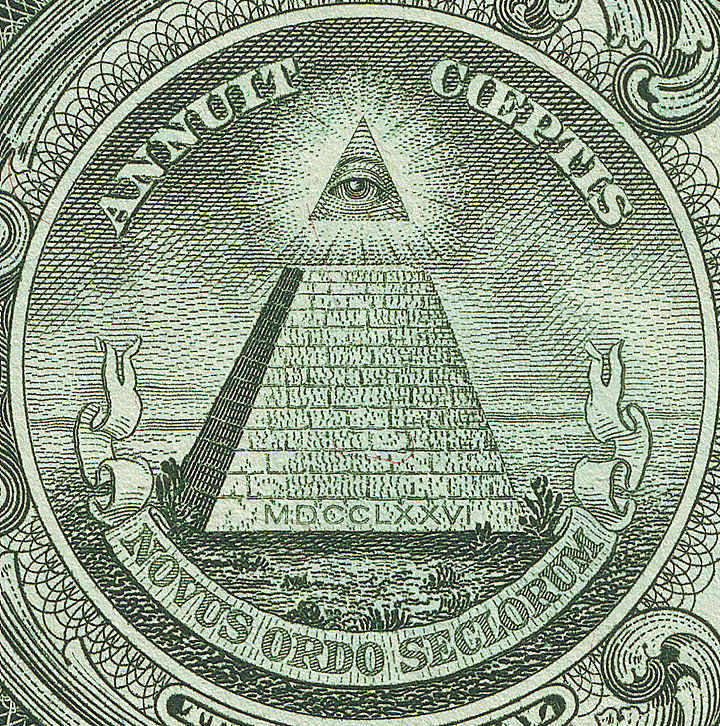

Take a dollar bill out of a wallet, turn it over, and there it is: a pyramid with its top missing and a glowing eye floating where the capstone should be. For a great many people that image is proof that a secret society runs the United States.
The documented history is odder and more human than that. It involves three committees, a congressional secretary, a Latin tag lifted from a Roman poet, and a Secretary of Agriculture who thought the whole thing looked like an advertisement for the New Deal.
Six years and three committees
On July 4, 1776, the same day it approved the Declaration of Independence, the Continental Congress asked Benjamin Franklin, John Adams and Thomas Jefferson to design a seal for the new country. According to Monticello's account, the three most famous men in the room came up with ideas nobody wanted. Franklin proposed Moses drowning Pharaoh in the Red Sea. Adams wanted Hercules choosing between virtue and sloth, and admitted it was too complicated for a seal.
The committee's hired artist, a Philadelphia artist named Pierre Eugène du Simitière, added the detail that mattered. His sketch included the eye of Providence looking down from above. Congress tabled the design in August 1776, and it stayed on the table.
A second committee tried in 1780 and a third in 1782, each leaning on a consultant. The third committee's man was William Barton of Philadelphia. For the back of the seal he proposed a pyramid of thirteen layers and, in his words, "In the Zenith, an Eye, surrounded with a Glory."
Congress was still not satisfied. It handed the whole stack of drawings to its secretary, Charles Thomson. Thomson kept Barton's pyramid, put the eye inside a triangle, made a bald eagle the star of the front, and added two Latin mottoes. Congress adopted his design on June 20, 1782, according to the State Department's official history of the seal.
What the eye meant in 1782
To an eighteenth-century viewer there was nothing cryptic about an eye in a triangle. It was a stock image in Christian art, the watchful eye of God, with the triangle standing for the Trinity. A version of it now hovers above Christ in Pontormo's 1525 painting of the Supper at Emmaus, and it appeared on churches and in devotional prints across Europe. In 1789 it would turn up at the top of the French Declaration of the Rights of Man.
Thomson explained his meaning in the remarks he sent to Congress. The eye and the motto above it, he wrote, allude to "the many signal interpositions of providence in favour of the American cause." In plain terms: the Revolution should have failed, it had not, and somebody up there seemed to be helping.
The pyramid stood for strength and duration, its thirteen courses for the thirteen states. It is unfinished because the country was. The Roman numerals at the base, MDCCLXXVI, give the year of independence.
The mottoes are just as plain. Above the eye is Annuit Coeptis, which the State Department renders as: He (God) has favored our undertakings. Below the pyramid is Novus Ordo Seclorum, a new order of the ages, a phrase Thomson adapted from Virgil.
That second motto carries a lot of weight in conspiracy literature, where it tends to become a New World Order. It says nothing about the world and nothing about a government. Thomson meant the American era that began in 1776.
Why the Freemason story fails
The Masonic theory has a timing problem. The eye of Providence did not become a standard Masonic emblem until 1797, when it appeared in Thomas Smith Webb's Freemason's Monitor, fifteen years after Congress approved the seal. Masons borrowed the symbol from the same common stock of religious imagery the seal's designers used. The pyramid has never been a Masonic symbol at all.
It also has a personnel problem. Of the men who shaped the seal, the only confirmed Freemason was Franklin, and his Moses design was discarded. Thomson, Barton and du Simitière were not Masons.
The Illuminati version is weaker still. The Bavarian Illuminati were real: a secret society of Enlightenment rationalists founded by the Bavarian professor Adam Weishaupt near Ingolstadt on May 1, 1776. By National Geographic's account the order had about 600 members by 1782, was banned by the Bavarian government in 1785, and was soon dismantled. No document connects it to Thomson, to Barton or to a seal committee in Philadelphia. The shared year is a coincidence, and the 1776 on the pyramid points to an event rather better known in America.
How it got onto the dollar
For 150 years almost nobody saw the pyramid. The front of the seal was cut as a metal die and pressed onto treaties. The reverse was never cut as a die at all, even after Tiffany and Company was commissioned to make one in the 1880s.
Then, in 1934, Agriculture Secretary Henry Wallace came across the design in a State Department booklet. By his own later account, he was struck by Novus Ordo Seclorum, which he read as the New Deal of the ages, and took it to Franklin Roosevelt with a suggestion for a coin. Roosevelt preferred the dollar bill. He checked whether Catholic voters might object to the eye, was reassured, and personally rearranged the layout so the pyramid sat on the left. The new silver certificates were printed in 1935.
Here is the one real Masonic thread, and it is worth stating plainly. Wallace and Roosevelt were both Freemasons, and by Wallace's account Roosevelt was taken with the eye as a Masonic image of God, the Great Architect. Two twentieth-century Masons liked an eighteenth-century design. That is the whole of it.
A symbol that outgrew its makers
The eye on the dollar is not a secret. Its makers wrote down what they meant, Congress voted on it in public, and the paperwork has been available ever since.
The conspiracy story gets the direction of travel wrong. Nobody smuggled a hidden meaning into the seal in 1782. The hidden meanings were poured in later, by readers who found a floating eye too strange to be merely pious. The real history is a reminder that the past is full of images that meant something ordinary to the people who drew them.