

Every autumn the same origin story makes the rounds. The Aztecs, it says, spent a month honoring Mictecacihuatl, the Lady of the Dead. Spanish friars could not stamp the festival out, so they folded it into the Catholic feasts of November 1 and 2 and gave it a new name. A 2023 marigold guide from a University of Florida extension office tells it almost exactly that way.
It is a tidy story, and parts of it may be true. It is also rejected by some of the best-placed historians in Mexico, who argue that much of what looks Aztec about the Day of the Dead is Catholic, European, or a 20th-century creation. Sorting the layers turns out to be harder than either side's slogans suggest.
The Catholic calendar
Start with what nobody disputes. Día de los Muertos falls on November 1 and 2, which are All Saints' Day and All Souls' Day. The 1907 Catholic Encyclopedia places the commemoration of all the faithful departed on November 2 and grounds it in the doctrine of purgatory: souls not yet fully cleansed can be helped by the prayers, alms and Masses of the living. Odilo of Cluny, who died in 1048, ordered it kept every year in the monasteries of his congregation, and Liège was the first diocese to adopt it. In Spain, Portugal and Latin America, the encyclopedia adds, priests said three Masses that day.
Much of the visible holiday has close cousins in Catholic Europe. Spain's All Souls' rituals had pan de ánimas, which the editors at HISTORY see echoed in pan de muerto. In Sicily, children wake on November 2 to hunt for bone-shaped almond cookies called ossa dei morti and sugar dolls left by the "dead." National Geographic reports that Mexico's sugar skulls belong to a sugar art tradition brought by Italian missionaries in the 17th century.
The Aztec case
The argument for indigenous roots rests on the Mexica ritual calendar. The Aztecs gave two of their twenty-day months, the ninth and tenth, to the dead, the first for children and the second for adults. The curator and historian Ruben C. Cordova argues that a memory of those months was compressed into two days inside the Catholic year. That would explain a Mexican peculiarity. All Saints' Day is set aside for dead children, the angelitos, and All Souls' Day for adults, a division Cordova says other Latin American countries with Day of the Dead traditions do not make.
There was also Quecholli, a festival for the war god Mixcóatl that ran from October 20 to November 8 and set altars of tamales near the burial grounds of warriors to help them on their journey. In Tenochtitlan, the dead were wrapped in a woven mat and guided toward Mictlan, the underworld, with offerings so they would not go hungry. The marigold, cempasúchil, carries a Nahuatl name. Wikipedia glosses the original word as twenty flowers, while the Florida extension guide renders it as flower of 400 lives. The poet Octavio Paz championed the idea of continuity in The Labyrinth of Solitude in 1950.
The weakness is the evidence. Cordova himself stresses how zealously the Spanish worked to extinguish indigenous religion, which makes its main features hard to reconstruct. A 2018 PBS NewsHour piece said the Aztecs began the tradition some 3,000 years ago, held it every August, and that the Spanish moved it to All Souls' Day on November 1. It offered no source for the first two claims, and the third has the wrong date.
The skeptics
The sharpest challenge came from Elsa Malvido, a historian at Mexico's National Institute of Anthropology and History who founded its workshop on the study of death. Malvido rejected an indigenous or even a mixed origin and traced the whole tradition to medieval Europe, pointing to altars for the dead, skull-shaped sweets and bone-shaped breads across Catholic southern Europe. She argued that even the all-night vigil is recent. In her account it followed Benito Juárez's Reform Laws, which pushed family burial vaults out of churches and into civil cemeteries, where wealthy families had servants guard the goods displayed on their altars.
Agustín Sánchez González, writing in the institute's journal Arqueología Mexicana, noted that the 19th-century press barely mentions a Day of the Dead in the modern sense, only long processions to cemeteries that sometimes ended in drunkenness. This camp points to the 1930s, when the government of Lázaro Cárdenas, driven by indigenismo and anticlericalism, separated the festivity from the Church and stressed Aztec imagery. The historian Ricardo Pérez Montfort has shown how far that went: officials promoted Quetzalcoatl as a substitute for the Three Kings. Malvido called the modern festival a "Cardenist invention."
Cordova adds a twist that cuts against both camps. Old Spanish practices survived best in poorer rural communities with large indigenous and mestizo populations, so archaic Catholic customs came to be mistaken for a "pure" indigenous core. The anthropologist Stanley Brandes, in a 1998 paper in Ethnohistory, traced the holiday's skulls and skeletons to two separate sources, the religious and demographic pressures of colonial times and the politics and journalism of the 19th century, and challenged the stereotype of a death-obsessed Mexico.
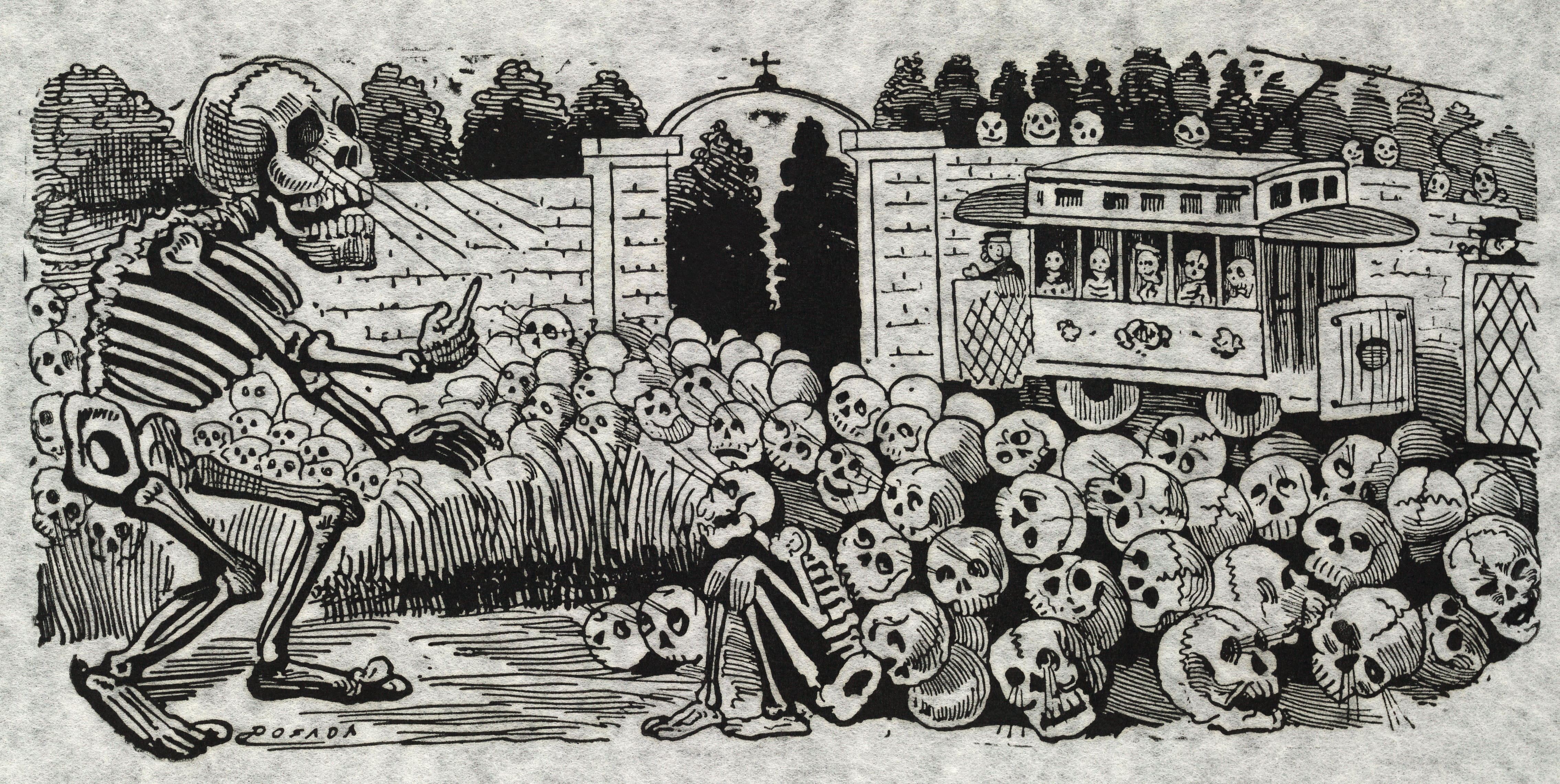
Posada's elegant skull
The holiday's most famous face makes the point clearly. Satirical verses called calaveras literarias were circulating in print by the 19th century. PBS dates the first published ones to 1849 in the newspaper El Socialista, while National Geographic places the form in the late 18th and early 19th centuries. José Guadalupe Posada, a printmaker from Aguascalientes who lived from 1852 to 1913, drew skeletons to mock politicians and social climbers. His Calavera Catrina, usually dated to about 1910 to 1912, lampooned Mexicans who copied European fashion. Its first certain publication was a broadside in 1913, the year he died.
PBS described La Catrina as derived from the goddess Mictecacihuatl. The record does not support that. Sánchez González argues that Posada had no interest in native culture, and that his macabre prints owe more to the European Renaissance and to Goya than to the skull racks of the Mexica. The indigenous touches came later, when Diego Rivera painted Catrina into his Alameda mural in 1946 and 1947, dressing her in a Tehuana skirt and a feathered serpent boa and turning a satire into a national emblem.
The newest layer
HISTORY notes that the holiday was observed mainly in rural indigenous areas until the 1980s, when it spread into the cities. The 2015 James Bond film Spectre opened with a vast Day of the Dead parade in Mexico City. No such parade existed. The city staged its first one on October 29, 2016, and about 250,000 people turned out.
UNESCO, which inscribed the festivity on its intangible heritage list in 2008, sidesteps the fight by calling it a fusion of pre-Hispanic rites and Catholic feasts. Its description includes a detail that fits neither tidy story: in the indigenous practice it records, the dead are sorted by cause of death, age, sex and sometimes profession, and each category has its own day.
Cordova makes the larger point with a single object. A stone skull carved by Aztec hands held enormous sacred power and could evoke sacrifice. Set by the Spanish on a holy water font or beneath a cemetery cross, the same carved skull became a memento mori. Nothing about the stone changed. Only the hands placing it did.