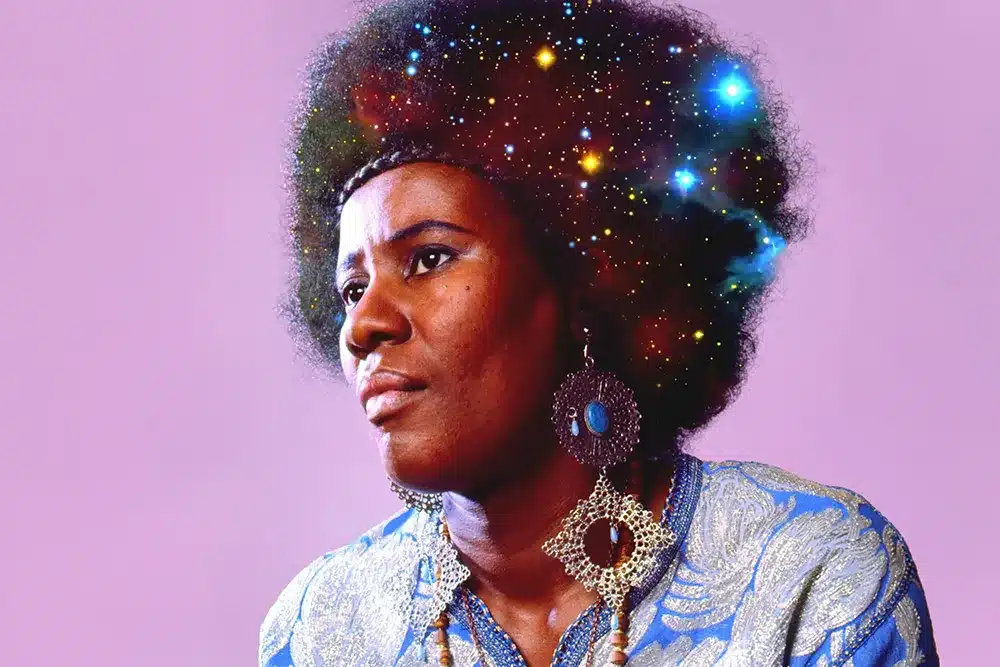
In July 1967, Alice Coltrane was 29 years old, the pianist in the most scrutinized band in jazz, and the mother of four small children. Then her husband died of liver cancer at 40, and within a few years she had stopped sleeping, stopped eating, and begun the strangest and most productive passage of her life.
What followed is often told as a tidy story of grief healed by a guru. The documented version is more interesting: a private ordeal she later gave a Sanskrit name, a run of records that still sound like nothing else, and then a deliberate walk away from the music business toward a hillside in Southern California.
The pianist from Detroit
She was born Alice McLeod in Detroit on August 27, 1937, and started piano lessons at seven. The church music of her childhood never left her playing. In 1959 she went to Paris and studied with the bebop pianist Bud Powell, then came home, worked the Detroit clubs, and joined vibraphonist Terry Gibbs's quartet in New York.
It was on a bill with Gibbs in 1963 that she met John Coltrane. They married in 1965, and she took over the piano chair from McCoy Tyner in his group, touring with him to San Francisco, New York and Tokyo during his final, most searching period. They had three sons together, and she brought a daughter from a brief first marriage.
John Coltrane died on July 17, 1967. Alice kept recording, at first in the house they had shared in Dix Hills, on Long Island. Her debut as a leader, A Monastic Trio, appeared in 1968, and she became known for bringing the harp into jazz.
The ordeal she called tapas
Her own account of the next stretch is spare. Her official biography says that in the late 1960s she entered a period of isolation marked by fasting, prayer and meditation. Other accounts, including the notes her later label published, are blunter: severe weight loss (down to about 95 pounds), sleeplessness and hallucinations.
She did not describe this as a breakdown. She described it as tapas, a Sanskrit term for austerity, the kind of burning away that a spiritual aspirant undergoes on purpose. Whether a reader takes that as theology or as a brave reframing of acute grief is not something the record can settle. What can be said is that she emerged from it working.
The turning point she named was a person. In 1970 she met Swami Satchidananda, the Indian yoga teacher who had become a fixture of the New York counterculture, and became his student. The official biography calls the meeting pivotal and says she then traveled to India and dedicated her life to God.
Two records in one year
Journey in Satchidananda was recorded mostly in November 1970 in the Dix Hills home studio, with one track taped live at the Village Gate that July, and released by Impulse! in February 1971. Pharoah Sanders plays saxophone. Cecil McBee and Charlie Haden share bass duties, Rashied Ali is on drums, and a tanpura drones underneath nearly everything. An oud turns up on the live track.
The sound is the argument. Her harp runs like water over a bass line that barely moves, and the music sits still in a way that hard bop never did. One track is titled "Stopover Bombay," a nod to a five-week trip to India and Sri Lanka planned for that December. Another is called "Something About John Coltrane." Grief and devotion are in the same room, and neither is asked to leave.
Universal Consciousness, recorded between April and June 1971 and released that September, is the fiercer record. It is her first on the Wurlitzer organ, which she took up after returning from India, partly because an instrument with multiple keyboards and bass pedals let her carry a whole ensemble by herself. Three tracks add a string quartet, with her arrangements transcribed by Ornette Coleman. The titles alone map her reading: "Hare Krishna," "Sita Ram," "O Allah," "The Ankh of Amen-Ra." This was not a conversion that slammed doors. It took in Hindu, Islamic and Egyptian imagery at once.
Swamini on the hill
By 1972 she had moved to California. In 1975, according to her official biography, she founded the Vedantic Center. Accounts differ on some of the details: one recent history places the center's beginnings a few years earlier in San Francisco, and the timing of the revelation that told her to leave secular life is given variously as the mid or late 1970s. What is consistent is the outcome. She took the name Turiyasangitananda, which her estate translates as the Transcendental Lord's highest song of bliss, and her students called her Swamini.
In 1983 the community settled on roughly 48 acres in the Santa Monica Mountains near Agoura, first as Shanti Anantam Ashram, later renamed Sai Anantam Ashram. A few dozen people lived there at a time. There were scripture studies midweek and a Sunday service that she led from the organ.
The music did not stop. It changed audience. Beginning with Turiya Sings in 1982, she made devotional recordings, issued on cassette and distributed through the ashram, in which she sang for the first time on record: Indian devotional chants carried by the gospel feeling of her Detroit childhood. Almost nobody outside the community heard them until a 2017 compilation brought them to a general audience.
She returned to a commercial label once, for Translinear Light in 2004, and toured briefly with her son Ravi in 2006. She died of respiratory failure in Los Angeles on January 12, 2007, at 69. The ashram property was sold in 2017, and its buildings burned in the Woolsey Fire the following year.
What the turn meant
It is tempting to read her life as two halves, the jazz musician and the swamini, with a crisis in the middle. The recordings argue against that. The church organ of Detroit is audible in the ashram tapes, and the ashram is already audible in the harp of 1970.
Her turn toward God was not a retreat from music but a decision about whom music was for. She spent the 1970s proving she could make records that mattered, and then spent more than two decades making music for a room of a few dozen people on a Sunday. Both choices were hers, and the second may have been the bolder one.